April 12, 2026 • Callum Reeve • 9 min reading time • Specs verified June 5, 2026
Carbon Steel Bushcraft Knives: The Rust Trade-Off, Scandi Grinds, and Which Handles Survive Real Field Use
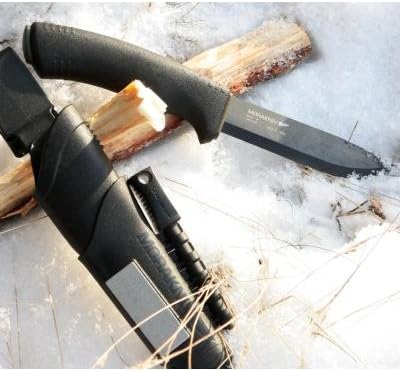
A bushcraft knife is, stripped to its essence, a fixed-blade cutting tool built for extended outdoor work — processing firewood, preparing food, carving stakes, building shelter. Most of the knives in this category are made from carbon steel (an iron-carbon alloy with minimal chromium, which means it can rust) rather than stainless steel (which contains at least 13% chromium and resists oxidation). That single difference — chromium content — explains most of the debate you’ll see on forums and in gear-shop back rooms. Carbon steel gets sharper more easily, takes an aggressive edge geometry called a Scandi grind very well, and costs less to sharpen in the field. Stainless is more forgiving if you forget to wipe the blade. If you’ve been camping a few seasons and are ready to invest $80–$300 in a knife that will last decades, this article will help you understand exactly what you’re trading and when the trade is worth it.
Why Carbon Steel Dominates the Bushcraft Category (And What You Give Up)
The short answer: carbon steel is tough, easy to sharpen on simple stones, and bonds to the Scandi grind geometry in a way that makes field maintenance genuinely simple. The long answer involves some metallurgy worth knowing.
Carbon steel grades like 1075, 1095, and O1 sit in a toughness range that handles the lateral stress of batoning (using a baton-sized stick to drive the spine of the knife through wood) without chipping. Per Knife Steel Nerds’ comparative data on toughness versus hardness tradeoffs, these alloys are typically hardened to 57–60 HRC — hard enough to hold an edge through sustained camp tasks, but not so brittle that they fail at impact. Higher-end carbon steels like O2 or high-carbon tool steels push that envelope further at a price.
What you give up is straightforward: corrosion resistance. Without significant chromium, carbon steel will oxidize in the presence of moisture and oxygen. In practical terms, that means:
- A wet knife left in a nylon sheath overnight can show surface rust by morning in humid climates
- Acidic foods (citrus, tomatoes, fish blood) accelerate oxidation dramatically
- Neglected blades in tropical or coastal environments can pit in weeks
The mitigation is simple but it is non-negotiable: wipe the blade dry after every use, apply a thin coat of food-safe mineral oil or beeswax, and use a leather sheath or a sheath with drainage and airflow rather than a sealed synthetic one. Owners across long-run BladeForums threads consistently report that the maintenance habit becomes second nature within a season — “it’s no different than oiling a cast iron pan” is a phrase that appears in those discussions with some regularity.
The payoff for that discipline: a well-used carbon blade develops a dark patina — a controlled oxidation layer — that actually provides mild passive corrosion resistance and gives the knife a visual history. Many bushcrafters deliberately accelerate patina formation with mustard or vinegar. It’s not just aesthetics; the patina is functional armor.
The Scandi Grind: Why It Matters More Than Most Buyers Realize
Grind refers to how metal is removed from the blade to form the cutting edge — it determines the cross-sectional geometry of the blade and controls how it performs in specific tasks. A Scandi grind (also called a Scandinavian grind or zero grind) is a flat bevel that runs from roughly the middle of the blade all the way to the edge without a secondary micro-bevel. Visualize a wedge shape viewed from the blade’s cross-section.
Here’s why that matters for bushcraft specifically:
By the numbers:
- Typical Scandi bevel angle: 10–12.5 degrees per side (very acute, very sharp)
- Typical convex or hollow grind on a comparable knife: 15–20 degrees per side
- Field sharpening time on a flat stone: 3–5 minutes for Scandi vs. 8–15 minutes for a full-convex grind
- Carbon steel at 58 HRC: reprofiling time roughly 40% less than comparable stainless at 60 HRC on a ceramic rod (per aggregated user reports on GearJunkie’s bushcraft roundup)
The Scandi geometry excels at wood carving and featherstick making because the flat bevel registers directly against the workpiece, giving the carver tactile feedback and precise control. It also makes field sharpening almost idiot-proof: lay the entire bevel flat on a whetstone and you’ve found your angle automatically. There’s no guesswork about maintaining a consistent angle that trips up newer sharpeners on more complex grinds.
The tradeoff is that Scandi grinds are not ideal for hard food prep — they can wedge in dense vegetables — and they’re more vulnerable to edge damage if someone tries to use them as pry tools. The geometry assumes you’re doing what a bushcraft knife is designed for.
Outdoor Life’s 2025 bushcraft buying guide explicitly calls the Scandi grind “the clearest signal that a knife was designed for sustained woodcraft rather than general utility,” which tracks with how experienced users describe it.
Handle Materials: What Actually Survives Extended Field Use
This is where a lot of buyers get surprised. A handle that feels solid at the kitchen table can degrade, loosen, or become dangerously slippery after three days of rain, sweat, and wood sap.
Birch or stabilized wood is the traditional Scandinavian choice — Morakniv’s birch handles and Bark River’s stabilized wood options represent opposite ends of the price range. Unstabilized wood is comfortable, looks beautiful, and has some grip even when wet, but it will swell, crack, or change dimension with prolonged moisture exposure if not finished properly. Stabilized wood (resin-impregnated under vacuum) largely eliminates this problem and is the reason Bark River’s handles survive hard use without warping. Owners in long-run forum reviews consistently describe stabilized wood as the best balance of feel and durability.
Micarta (layers of canvas, linen, or paper embedded in phenolic resin) is the standard for users who want zero maintenance. It doesn’t swell, shrink, or absorb moisture. Texture varies dramatically by manufacturer — coarse canvas micarta maintains grip when wet and bloody; smooth linen micarta can feel almost slick. ESEE and Benchmade both use micarta on several of their bushcraft-adjacent designs, and owners frequently report that the handle outlasts the blade finish by years.
G10 (fiberglass laminate) is dimensionally stable and extremely hard-wearing. It’s lighter than micarta at comparable dimensions and takes aggressive texturing well. The downside reported by long-run users: G10 can feel “dead” in cold weather compared to natural or semi-natural materials, and some find it fatiguing on multi-hour carving sessions because it lacks the slight flex of natural handles.
Rubber-based or Kraton handles appear on survival-oriented designs and are genuinely grippy in any condition, but they attract dirt and debris, can degrade with prolonged UV and solvent exposure, and don’t give the controlled feedback that serious woodcarvers want.
The handle-to-tang connection is as important as the material itself. A full tang (the metal of the blade extending through the entire handle) is the structural gold standard for hard-use tools. A hidden tang or rat-tail tang (narrower metal encased in the handle) is adequate for most camp use but will fail under batoning stress if the design isn’t engineered carefully. Mora’s Companion uses a rat-tail tang and survives enormous abuse at $20 because it’s designed well at that interface; cheaper copies of that geometry often aren’t. Bark River and custom makers at the $300+ tier almost universally use full tang or properly engineered hidden tang construction.
If X, Then Y: The Decision Rules
You’ve read the tradeoffs. Here’s how to map them to a buying decision.
If you’re primarily doing woodcraft — carving, featherstick prep, camp furniture — and you’re willing to spend five minutes on maintenance: Carbon steel with a Scandi grind is the correct answer at nearly every price point. A Morakniv Garberg (under $80, 14C28N — technically a high-chromium “stainless” but positioned and used identically to carbon in the field) is the entry argument; Bark River’s Bravo series in 3V or A2 tool steel represents the $250–$380 case for durability and edge retention over years of use.
If you’re cooking more than carving, or operating in coastal or tropical environments where daily maintenance is genuinely impractical: Lean toward a stainless steel option or a high-chromium tool steel like CPM-3V (which bridges the gap — high-carbon behavior, modest corrosion resistance). Gear Junkie’s long-term user reports flag this environment-specific split explicitly.
If you’re equipping clients as a guide or outfitter: Carbon steel requires buy-in on maintenance that clients who rent gear won’t give it. Mid-tier stainless blades (S30V, 14C28N) with Scandi or convex grinds are more defensible operationally.
If you’re buying for the first time at under $100: The Morakniv Companion HD in carbon steel is the most-cited entry recommendation across Outdoor Life, Gear Junkie, and BladeForums long-run threads. Not because it’s the best knife — it isn’t — but because it will teach you the correct maintenance habits without punishing you financially during the learning curve.
If you’re investing $200–$400+ and want a knife that gains character over a decade: Bark River’s Bravo 1 or ESEE-6 in high-carbon steel (with a stabilized wood or canvas micarta handle) are the names that appear most consistently in long-arc owner testimony. Knife Steel Nerds’ published data on CPM-3V specifically supports the toughness case for hard-use applications if you’re choosing a premium steel grade.
One final note: sheaths deserve as much attention as the knife. A leather sheath that breathes, drains, and allows a thin oil coat on the blade between uses is the correct companion to a carbon steel blade. A sealed kydex sheath that traps moisture against an unoiled blade is how you find surface rust after a weekend trip. At the $300+ tier, makers like Chris Reeve and Bark River pair their blades with leather or hybrid sheaths by default — and that pairing is not accidental. It’s the full system, and the system is what survives real field use.