May 18, 2026 • Callum Reeve • 9 min reading time • Specs verified June 5, 2026
Buck 110 and the Traditional Folder Case: Lockback Geometry, 420HC Steel, and Why These Knives Still Make Sense
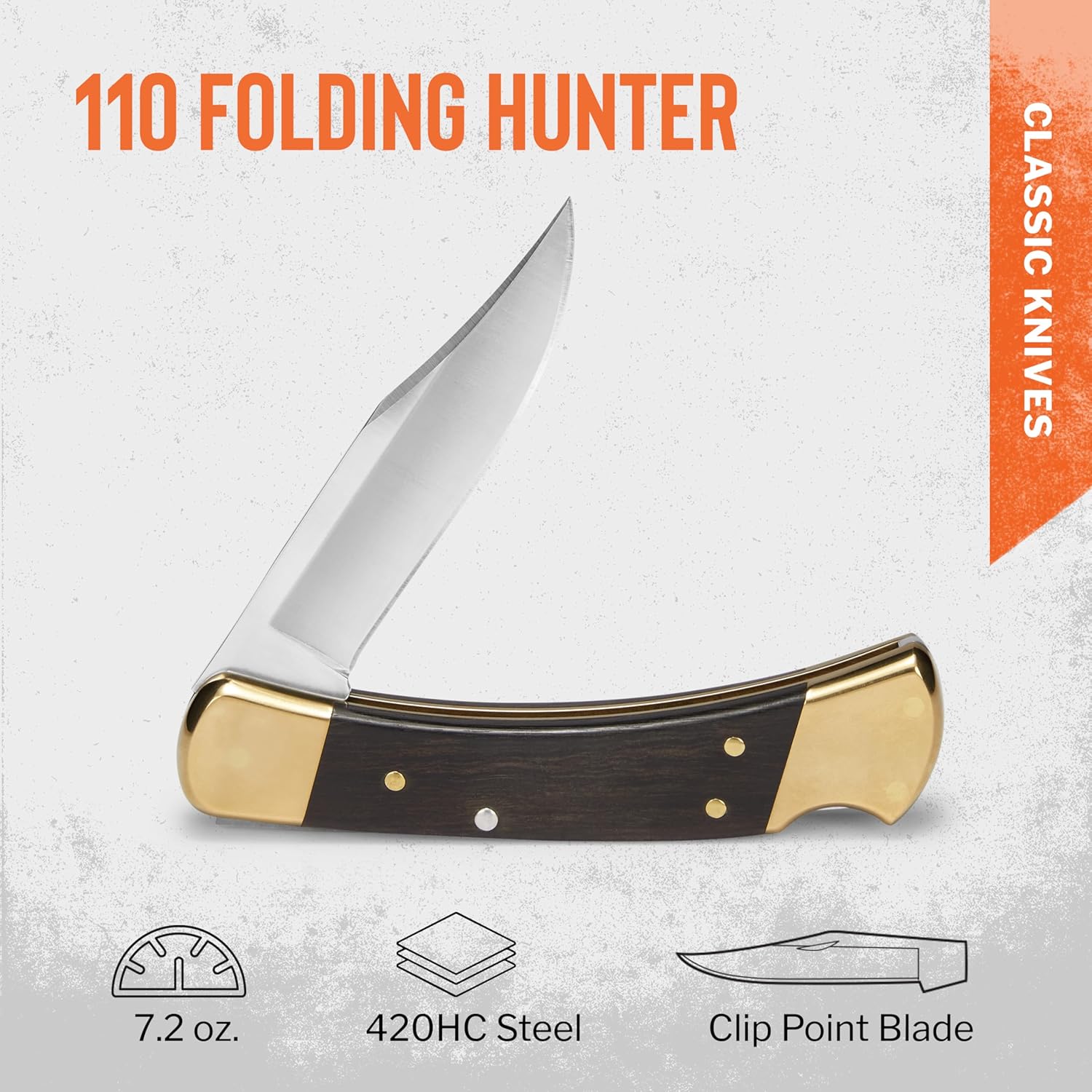
If you’ve spent any time in knife shops or hunting forums, you’ve seen the Buck 110 sitting there — big brass bolsters, a clip-point blade that snaps open with a satisfying click, and a price tag that makes you wonder if there’s a catch. There isn’t. The Buck 110 is a lockback folder: a pocketknife whose blade folds into the handle and is secured open by a spring-loaded bar (the “lockback”) that snaps into a notch in the blade’s spine. It’s been made essentially the same way since 1964. In a market crowded with steel alloy debates and $300 titanium framelock designs, that raises a fair question — why does this old design keep selling, and does it actually make sense for someone who’s moved past the beginner phase? That’s exactly what this guide works through: what the 110’s geometry and steel actually deliver, where traditional folders fit the modern upgrade ladder, and the tradeoffs that should drive your decision.
What “Traditional Folder” Actually Means — and Why It Still Has a Constituency
Before we get into specific numbers, it helps to be precise about what we mean. “Traditional folder” typically refers to knives built on older American or European pocketknife conventions: lockback or slipjoint locking mechanisms, full bolsters (the metal end pieces that protect the handle scales), a clip-point or drop-point blade with a relatively conservative edge geometry, and often natural or semi-natural handle materials like wood, bone, or jigged synthetic. The Buck 110 is the archetype. Case Cutlery’s line of slipjoint patterns — the Trapper, the Stockman, the Sodbuster — is the other major American branch of the tradition.
These designs aren’t nostalgia products for everyone who buys them. They persist because they solve a real set of use cases:
Legal carry profile. A significant number of U.S. states, Canadian provinces, and European jurisdictions that restrict “assisted-opening” or “locking blade” knives make exceptions for traditional folding patterns or treat them more leniently in practice. KnifeInformer’s traditional folder buyer guide notes that the lockback and slipjoint have consistently broader carry legality than liner locks or framelock designs in jurisdictions that key restrictions to opening mechanism. If you guide clients in mixed-jurisdiction environments, this matters.
Social context. A Buck 110 or a Case Trapper reads as a hunting knife or a working tool in social contexts where a modern tactical folder with a pocket clip and a tanto blade reads as a weapon. That perception gap has real-world consequences for guides, outfitters, and anyone who uses a knife in front of clients or the public.
Repairability and parts availability. The Buck 110’s parts haven’t meaningfully changed in six decades. A broken spring or worn pivot bushing is a fixable problem. Buck’s Forever Warranty — a no-questions free repair or replacement policy for original-owner defects — backs that up. Outdoor Life’s annual hunting knife reviews consistently flag this warranty as among the most genuinely useful in the category.
Lockback Geometry: What It Does Well and Where It Gives Ground
The lockback is a deceptively simple mechanism. When the blade reaches full open, a bar running along the spine of the handle — under spring tension — drops into a notch cut into the blade’s tang (the unsharpened metal base of the blade that sits inside the handle). To close, you press down on the exposed rear section of the lockbar, releasing it from the notch.
Strengths of the geometry:
Symmetrical load distribution. A lockback engages the blade from directly behind, along the axis of cutting force. Under normal cutting load, the lock is being pushed into engagement, not out of it. This is different from a liner lock (where a thin metal leaf flexes sideways to catch the blade) — the lockback’s on-axis geometry is theoretically more resistant to lock failure under hard, spine-to-edge pressing cuts. Blade Forums community discussion on Buck 110 long-term use repeatedly notes that owners who use these knives for field dressing and camp work over years rarely report lock rock or engagement failure.
Handle integration. Because the lockbar runs the full length of the spine, the 110’s handle is structurally rigid compared to designs where lock components live independently. That contributes to the solid, “no flex” feel owners report.
Where it gives ground:
One-hand opening. A standard lockback has no thumb stud, flipper tab, or assisted mechanism. The Buck 110 is a two-hand knife. For EDC use cases where one-hand deployment matters, a modern liner lock or framelock folder with a flipper wins outright.
Weight and bulk. Published specs put the Buck 110 at 7.2 oz (204g) and 4.875 inches closed. That’s heavy for a folder. By comparison, a Benchmade Bugout (a popular mid-tier EDC) is 1.85 oz closed. If pocket weight is a daily factor, the tradeoff is significant.
Disassembly for deep cleaning. The 110 can be disassembled, but it requires care and the right tools. Owners on Blade Forums report the lockbar spring tension being easy to lose track of during reassembly. It’s not a maintenance nightmare, but it’s not a quick-release tool-free teardown either.
420HC Steel: Honest Assessment, Not an Apology
420HC is the steel where most premium-tier readers’ instincts say “walk away.” Let’s look at what the numbers actually say.
By the numbers — Buck 110 stock steel:
| Property | 420HC (Buck heat treat) | 1095 (common budget comparison) | S35VN (premium tier) |
|---|---|---|---|
| Rockwell Hardness | ~58–60 HRC | ~57–58 HRC | ~59–61 HRC |
| Corrosion resistance | Excellent | Poor | Very good |
| Edge retention | Moderate | Moderate | High |
| Ease of field sharpening | High | High | Moderate |
420HC is a stainless steel with roughly 0.45% carbon and high chromium content. On its own, at a mediocre heat treat, it’s a soft stainless that holds an edge poorly — which is the reputation the grade carries. Buck’s in-house heat treatment process, however, consistently brings 420HC to 58–60 HRC, which is meaningfully higher than most budget implementations of the same steel. Knife Steel Nerds’ compositional analysis of 420HC explicitly notes that the grade’s performance ceiling is determined far more by heat treatment than by baseline composition — and that Buck is one of the few production makers consistently hitting the upper end of what the alloy allows.
What that means in practice: owners report that Buck 420HC holds a working edge through light to moderate field use — general camp work, food prep, field dressing — and sharpens back to a usable edge quickly on basic ceramic or diamond stones without needing specialized abrasives. It won’t outperform CPM-3V or S35VN on edge retention over long cutting sessions. That’s not the use case it’s optimized for. For a hunting or camp knife that might get handed to a client, used hard for a season, and then need a quick touch-up in the field, the ease-of-maintenance tradeoff is a genuine argument in favor of the steel, not just a rationalization.
Where 420HC loses the argument: extended cutting tasks, production environments, or any use case where you’d rather sharpen less often and work harder between sessions. At that point, spending up to S35VN or CPM-3V in the same form factor is the right call.
The Case Cutlery Comparison and Where Traditional Folders Diverge
Buck and Case occupy neighboring territory but aren’t interchangeable. Case’s slipjoint patterns — meaning the blade is held open by spring tension alone, without a locking mechanism — represent the older American tradition. There’s no lock to fail, but there’s also no lock to rely on. Slipjoints require a deliberate backpressure technique to keep the blade from folding; they’re designed for lighter work and have significant carry-legality advantages in jurisdictions that restrict any locking blade.
Case uses its own stainless alloy (CV or Tru-Sharp, depending on line) with heat treatments comparable to Buck’s 420HC in the production tier. The finish, bolster work, and handle jigging on Case knives are areas where long-run owners consistently highlight Case’s quality — the fit between blade and spring is a craft detail that reviewers at BladeHQ and KnifeInformer both call out as a distinguishing factor between Case and cheaper slipjoint competition.
The practical decision split:
- If locking reliability under load matters, Buck 110 or a lockback variant.
- If legality in no-lock jurisdictions or traditional pattern collecting is the driver, Case’s lineup is the natural fit.
- If you want a traditional folder with modern steel and don’t mind paying for it, makers like Great Eastern Cutlery or Queen Cutlery produce traditional patterns in higher-spec steels, though availability and maker stability in 2025–2026 market conditions vary.
Decision Framework: If X, Then Y
Here’s how to think about whether a traditional folder belongs in your kit or buying rotation right now.
If your primary use case is field dressing, camp utility, or client-facing guide work — and you want a knife that’s legal everywhere, easy to sharpen, backed by a real warranty, and won’t cause a conversation about weapons — the Buck 110 is a genuine workhorse choice at its current street price of roughly $40–$55 new. The performance ceiling is real, but so is the ceiling on what the use case demands.
If you’re evaluating traditional folders as a collector or secondary-market play — Case’s limited-run patterns, handle material variants, and shield configurations have a legitimate collector following. Blade Forums tracking threads show secondary-market premiums on discontinued handle materials and shield configurations. This is a slow-burn category, not a quick flip.
If you want one-hand deployment, lighter carry weight, or higher edge retention for extended cutting tasks — a traditional folder is the wrong tool regardless of steel grade or maker. A Benchmade 940, Spyderco Paramilitary 2, or ESEE Zancudo in your preferred steel will serve those priorities better. That’s not a criticism of the 110; it’s a different tool.
If you’re building out a guide or outfitter kit — consider the Buck 110 as the client-facing or backup piece rather than the primary field knife. Its ease of maintenance, legality profile, and low replacement cost make it a rational choice for knives that live in gear bags and get used by multiple hands.
The Buck 110 isn’t a compromise you settle for. It’s a tool with a defined envelope, built consistently for over sixty years, priced honestly, and backed by one of the few production warranties in this category that actually pays out. Know what you’re buying it to do, and it still makes sense in 2026.