May 22, 2026 • Callum Reeve • 10 min reading time • Specs verified June 5, 2026
Benchmade Bugout vs. Spyderco Para Military 2: A Steel-and-Value Breakdown for the $150–$200 Buyer
If you’ve been carrying a budget folding knife — the kind with a stainless blade and a plastic handle that cost you twenty-five dollars — and you’re finally ready to step up, the $150–$200 range is where the real decisions start. At this price, you’re not just buying a sharper blade; you’re choosing between genuinely different design philosophies, steel alloys that hold an edge measurably longer, and hardware built to last years of daily carry. Two knives dominate every conversation in this bracket: the Benchmade Bugout and the Spyderco Para Military 2 (almost always shortened to PM2). Both sit around $160–$185 at most authorized retailers as of mid-2026. Both have loyal followings. And they’re different enough that buying the wrong one for your use case is a real possibility. This breakdown is designed to help you spend that money well.
| EDITOR'S PICKBenchmade - Bugout Outdoor EDC… | Mid-tier[Spyderco Tenacious Folding Pock…](https://www.amazon.com/dp/B007CK1MNU?tag=greenflower20-20) | Budget pickSpyderco Para Military 2 Foldin… | |
|---|---|---|---|
| Blade Steel | CPM-S30V | 8Cr13MoV | CPM S45VN |
| Blade Length | — | 3.3" | 3.4" |
| Hardness | 58-60HRC | — | — |
| Handle Material | Grivory | FRN | G-10 |
| Price | $200.00 | $59.13 | |
| See on Amazon → | See on Amazon → | See on Amazon → |
What You’re Actually Comparing: Design Philosophy First
Before we get into steel grades and grind geometry, it’s worth naming the fundamental split between these two knives — because it shapes every other decision the buyer has to make.
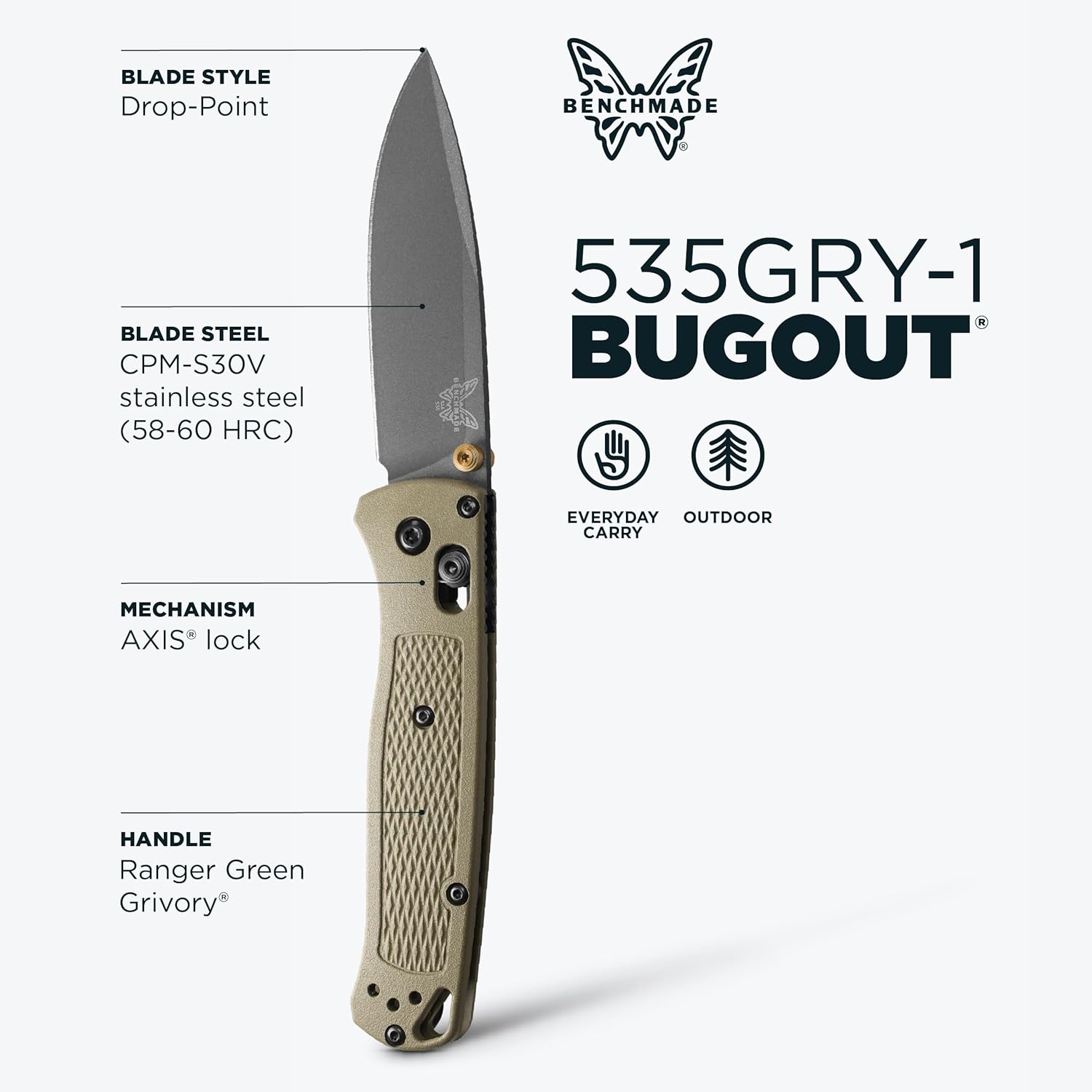
The Bugout is Benchmade’s answer to one question: how light can a full-size, high-quality folder be? At roughly 1.85 oz (52 g), it is remarkably — almost suspiciously — light for a knife with a 3.45-inch blade. Benchmade achieved this by pairing a carbon-fiber-reinforced nylon handle (marketed as “Grivory”) with an open-frame design that removes as much material as possible. The result is a knife you genuinely forget is in your pocket. That’s the Bugout’s entire pitch.
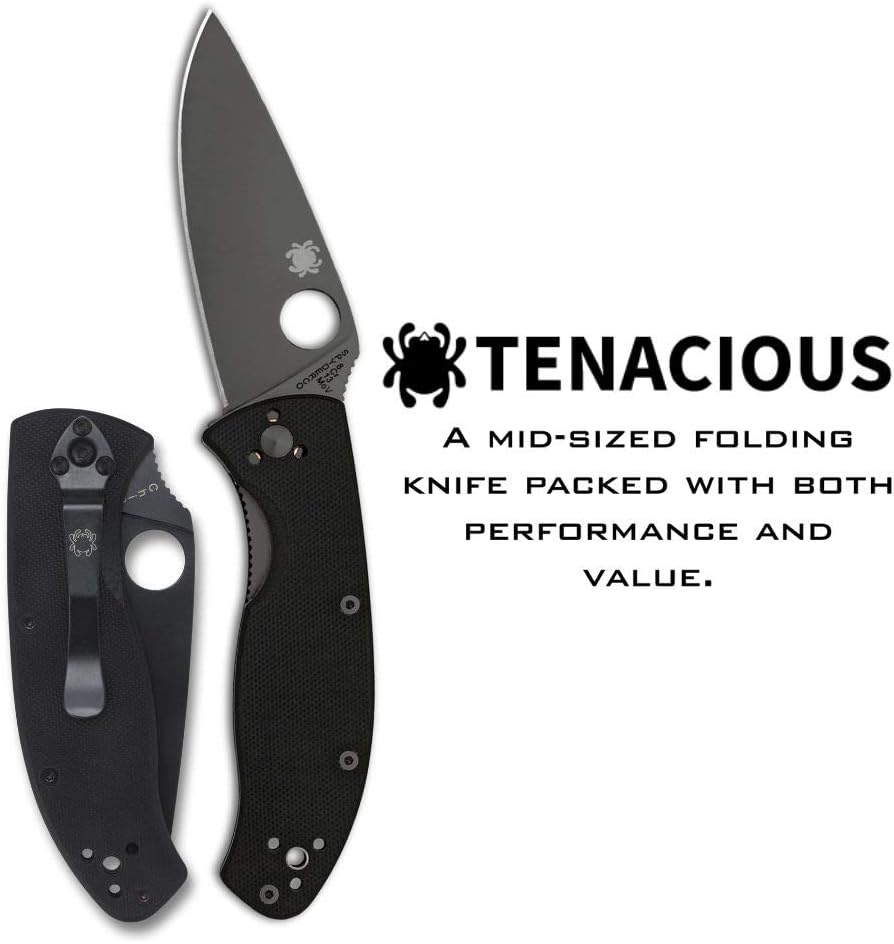
The Para Military 2 asks a different question: what’s the strongest, most capable folder we can build without crossing into “too heavy for EDC”? Spyderco’s answer is a full G-10 handle (a fiberglass-based composite prized for grip and durability), a compression lock mechanism (one of the strongest lock types in production folding knives), and a blade grind optimized for slicing performance. The PM2 weighs around 3.75 oz (106 g) — more than twice the Bugout. You will feel it in your pocket.
Neither philosophy is wrong. They’re pointed at different people.
Steel Deep Dive: What the Standard Models Actually Ship With
Here’s where a lot of buyers get confused, because both knives are available in multiple steel configurations depending on the production run and the retailer.
Standard Bugout ships in CPM-S30V, a powder-metallurgy stainless steel developed by Crucible Industries specifically for cutlery. The “CPM” prefix indicates a crucible particle metallurgy process, which distributes carbides more evenly than conventional steel — translating to better edge retention and toughness compared to simpler stainless grades like 8Cr13MoV or AUS-8. S30V is considered a genuine workhorse in the premium segment: excellent corrosion resistance, solid edge retention, and relatively forgiving to sharpen on a medium ceramic rod.
Standard Para Military 2 also ships in CPM-S30V in its base configuration — which is worth noting. At the same price point, you’re getting the same steel grade in both knives. Where Spyderco differentiates is at the upgrade tier: Sprint Run variants of the PM2 regularly appear in CPM-S90V, CPM-20CV, or M390 (the latter two are nearly metallurgically equivalent, both being high-carbon, high-vanadium stainless steels with exceptional edge retention). These sprint runs often command $220–$280 and sell out within days. Knife Steel Nerds, in their published comparison of CPM-S30V versus CPM-S90V, documents a meaningful step up in carbide volume and wear resistance in S90V at the cost of harder sharpening sessions. If you catch a sprint run at a fair price, the steel upgrade is real.
The Bugout also appears in S90V and M390 in Benchmade’s Gold Class and limited production lines, but for most buyers in the $160–$185 window, both knives arrive in S30V.
Standard production specs at a glance:
| Attribute | Benchmade Bugout | Spyderco Para Military 2 |
|---|---|---|
| Steel | CPM-S30V | CPM-S30V |
| Blade length | 3.45 in | 3.47 in |
| Weight | 1.85 oz | 3.75 oz |
| Lock type | AXIS lock | Compression lock |
| Handle material | Grivory (nylon composite) | G-10 |
| Street price (mid-2026) | ~$165 | ~$175 |
Three Head-to-Head Categories That Actually Decide the Purchase
Lock Mechanism — AXIS vs. Compression
This is the comparison that intermediate buyers sometimes gloss over — and it matters more than the steel similarity or the weight difference.
Benchmade’s AXIS lock uses a small spring-loaded bar that rides in milled channels on both handle scales and drops into a notch in the blade tang when the knife opens. To close it, you pull the bar back with your thumb and forefinger while folding the blade. It’s ambidextrous by design — a genuine advantage for left-handed carriers — and it allows the blade to be closed safely one-handed once you’re practiced. Long-term owners posting on BladeForums, in the Benchmade AXIS lock longevity thread and aggregated across multiple years of owner reports, note that the omega spring occasionally needs replacement after very heavy use; it’s a known wear point. Benchmade’s LifeSharp service and warranty program addresses this, making it a manageable issue rather than a dealbreaker. BladeHQ, in their Folding Knife Buyer’s Guide (2025 edition), ranks the AXIS mechanism among the most refined production folder locks available at this price.
Spyderco’s Compression lock is structurally different in a way that matters: the locking bar sits on the spine of the handle, and closing the knife applies pressure to a ramp that disengages the lock — rather than placing your fingers anywhere near the blade’s closing path. This is a genuine ergonomic advantage that knife safety instructors consistently cite. The compression lock is also known for its lockup solidity. KnifeInformer, in their Para Military 2 review, describes the compression lock as among the most refined production folder locks in this price range, an assessment that has held up across subsequent years of owner reporting. Across aggregated BladeForums owner threads, blade play or rattling in a PM2’s compression lock is rarely reported even after thousands of open-close cycles.
Verdict for this category: If ambidextrous AXIS operation matters, the Bugout is the stronger choice. If closing-hand safety and lock robustness under hard use are priorities, the PM2 wins this category.
Spyderco
$59.13
In stock on Amazon
Check price on AmazonBlade Geometry — Hollow Grind vs. Flat Saber Grind
The PM2’s blade uses a flat saber grind with a full flat primary bevel — geometry prized for slicing tasks. It reduces drag, allows the blade to push material away cleanly, and performs well across a wide range of general cutting tasks from food prep to breaking down cardboard. Owners and reviewers consistently describe the PM2 as an aggressive slicer for its size. The flat grind also rewards long-term sharpening maintenance well; as the blade is thinned over successive sharpenings, the geometry remains predictable.
The Bugout uses a hollow grind, which creates a concave profile on the blade face. Hollow grinds produce a thinner edge apex that can be exceptionally sharp out of the box. The geometry is slightly more fragile under hard lateral stress than a flat grind — it’s less appropriate for any task that puts torque on the edge (which includes prying, a practice no one should apply to a folder regardless of grind). For EDC paper-cutting, opening packages, and pocket tasks, the hollow grind performs superbly. GearJunkie, in their Best EDC Knives roundup (2025 edition), highlighted the Bugout’s hollow grind as a key contributor to its out-of-box sharpness, describing the cutting feel as noticeably refined compared to heavier production folders in the same category.
Verdict for this category: For slicing-intensive work and long-term reprofiling, the PM2’s flat grind wins. For out-of-box sharpness and light daily carry tasks, the Bugout’s hollow grind is more than adequate.
Spyderco
$59.13
In stock on Amazon
Check price on AmazonHandle Material and Carry Character — Grivory vs. G-10
The weight difference between these two knives (roughly 1.85 oz vs. 3.75 oz) is almost entirely a function of handle material and frame design.
Grivory — Benchmade’s carbon-fiber-reinforced nylon — is lightweight, smooth, and offers a refined feel in hand. The open-frame construction of the Bugout amplifies this: there’s simply less material present. The tradeoff is grip texture. In dry conditions, Grivory is comfortable and secure. In wet or greasy conditions, smooth nylon composites can feel less confident than more aggressively textured materials. The Bugout has one of the most active aftermarket communities in production folders; scale replacements in carbon fiber, titanium, and machined aluminum are widely available from aftermarket makers, allowing buyers to customize grip texture and aesthetics without voiding warranty coverage.
G-10 — a fiberglass-epoxy laminate — is heavier than Grivory but significantly more textured and rigid. Spyderco’s G-10 scales on the PM2 are contoured and checkered in a way that provides confident grip even in wet or heavily gloved conditions. G-10 also ages exceptionally well; it doesn’t compress or degrade noticeably over years of hard use, and it takes on a worn-in character without losing structural integrity. For users who work outdoors, in wet environments, or who simply want a handle that grips reliably without aftermarket modification, G-10 is the stronger choice.
Verdict for this category: Grivory and the open-frame Bugout design win on carry weight and customizability. G-10 wins on grip security, durability under real use, and low-maintenance performance over years of carry.
Spyderco
$59.13
In stock on Amazon
Check price on AmazonWho Should Buy Which Knife
Buy the Bugout if:
- You dress in lightweight fabrics, wear slacks, or simply prioritize not feeling the knife after an eight-hour day. Two ounces sounds trivial; accumulated over a long carry day, it isn’t.
- Your EDC use is light-to-medium: envelopes, packages, occasional food prep, nothing punishing.
- Ambidextrous operation matters — the AXIS lock is genuinely symmetrical in a way the compression lock is not.
- You want to customize. The Bugout aftermarket is extensive: scales, clips, and hardware upgrades are widely available and well-documented by the community at BladeForums.
Buy the Para Military 2 if:
- You use your folder hard and often — daily box breaking, light food prep, any task where grip security under load matters.
- You work in wet or dirty conditions where G-10’s texture outperforms smoother handle materials.
- You want the most robust lock mechanism in this price range without paying for a custom or semi-custom knife.
- You plan to sharpen and maintain one knife for years; the flat saber grind rewards long-term maintenance more predictably than a hollow grind.
If you’re genuinely on the fence and the weight difference doesn’t decide it: the PM2 is the better tool for most people who will actually use their folder for demanding tasks. The Bugout is the better knife for most people who will carry daily and use lightly. That’s not a criticism of either — it’s the honest shape of the tradeoff.
A Word on Gray Market and Warranty at This Price Point
At $160–$185, counterfeits are less common than at the sub-$50 tier, but gray-market stock — genuine knives sourced outside authorized dealer channels, sometimes missing warranty coverage — is a real issue. Both Benchmade and Spyderco operate authorized dealer networks and offer meaningful service programs. Benchmade’s LifeSharp service provides free sharpening for the life of the knife; Spyderco’s warranty covers manufacturing defects and is honored through authorized channels. Authorized retailers including BladeHQ, KnifeCenter, and the manufacturers’ own direct websites are reliable sources. If a price is more than 20% below street pricing from an unfamiliar seller, confirm authorized-dealer status before purchasing.
The Bottom Line
The Bugout and the Para Military 2 are both exceptional knives at a price that represents genuine quality per dollar. In the $160–$185 window as of mid-2026, you’re getting CPM-S30V steel in either case — the meaningful differences are weight, lock mechanism, blade geometry, and what kind of daily work you’re asking the knife to do.
If carry comfort and weight are primary: Bugout.
If grip security, lock robustness, and hard-use slicing performance are primary: Para Military 2.
If you can only own one folder and you’re not yet sure which direction your habits will run: Para Military 2 — it’s the more forgiving tool for a wider range of tasks, G-10 ages better than Grivory under real use, and the compression lock is the stronger mechanism for demanding carry environments.
Neither choice is a mistake. Both are knives you’ll still be carrying — and recommending to friends — five years from now.